
Live in production
Rudy
2026A campus safety assistant that answers from verified documents or hands off to a human.
Campus safetySolo build
301 adversarial checksView case study
AI & data systems engineer · Cal Poly
San Luis Obispo, California

Cal Poly Computer Engineering, Class of 2026 · Building at Cal Poly EHS & Risk Management
Open to roles & select projectsSelected work
Tools people use. Systems put to the test. A look inside the decisions, the evidence, and the edges of each build.
A campus safety assistant that answers from verified documents or hands off to a human.
301 adversarial checksView case study

An insurance renewal sandbox that blocks approval when the evidence does not add up.
114 passing testsView case study

Inspection reports become tracked violations and the Excel exports the team already uses.

A scattered archive becomes one searchable registry, with a source behind every record.

A physics-anchored, six-layer detector catches eight spoofing attacks on a destroyer, live in 3D.

Adaptive power management improved mission duration and reduced power draw in field tests.

Risk scoring and document-grounded AI for a team-built Cal Poly platform.

A ground-up rebuild of an enterprise AI-training company’s site, now in production.
Work with me
I build with Claude Code, Codex, and whichever model fits the job. They are tools that carry my speed and my creativity; the architecture, the review, and the accountability are mine. Every line is reviewed, tested, and handed to you with the repo, the docs, and the accounts.
How I build, and what you ownYou get
Clock
5 business days. Staging URL by day 3.
Starts with a written scope, not a discovery call.
You get
Clock
2 to 3 weeks.
Starts with a half-day look at the spreadsheet and the people who use it.
You get
Clock
2 to 4 weeks.
Starts with your documents and twenty questions your team actually asks.
You get
Clock
2 to 4 weeks.
Starts with your current site, your customers, and what you want them to feel.
You get
Clock
3 to 6 weeks.
Starts with a map of your current systems and the three questions you cannot answer today.
You get
Clock
5 business days.
Starts with read access to the repo and the hosting account.
You get
Clock
Monthly.
Follows a build. It is not sold on its own.
How I think
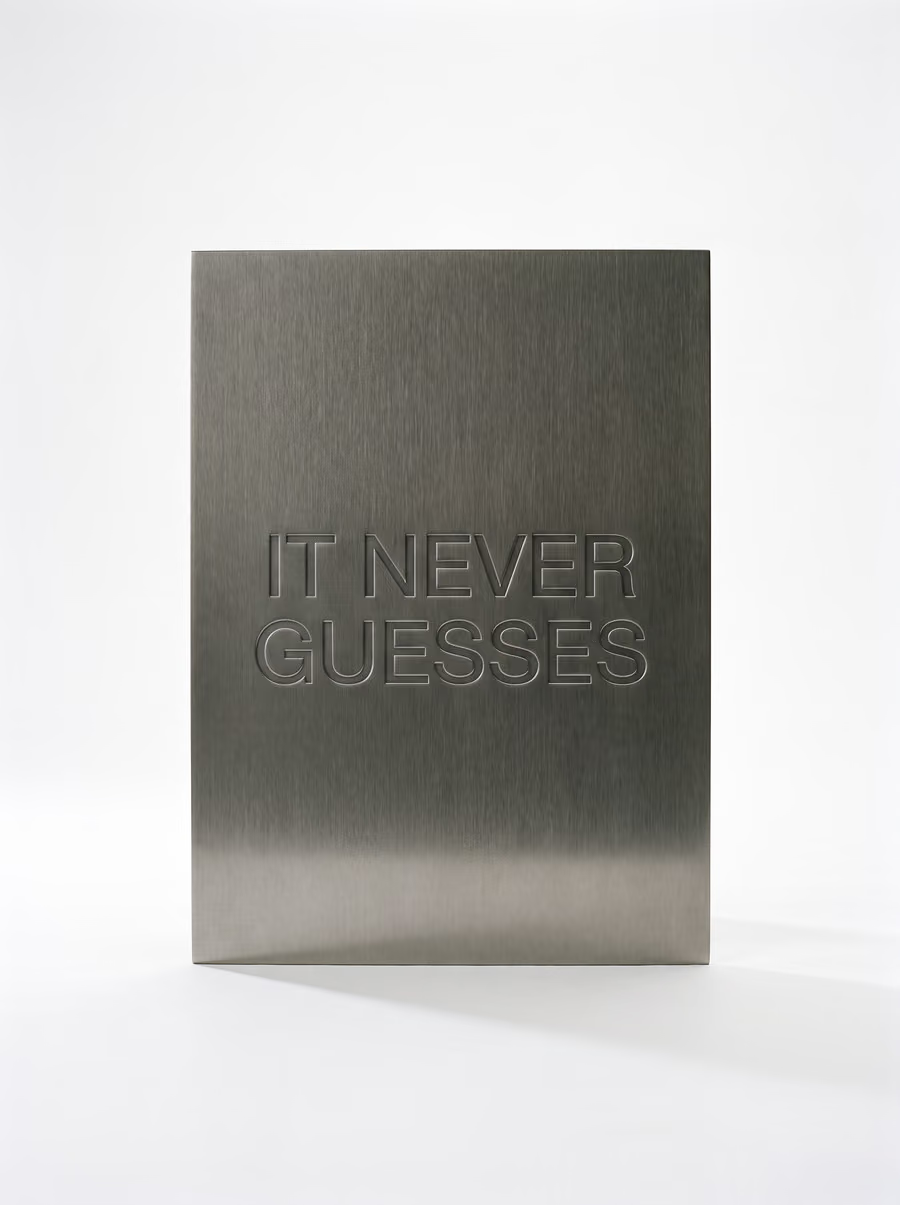
Getting a demo to work is the beginning.
Earning trust is the engineering.
Rudy answers from a verified corpus or says it does not know. A build gate blocks release when an emergency number cannot be verified.
Inside Rudy’s trust architectureWhen a license or compliance duty is on the line, the logic is deterministic. The model can explain a decision. It does not get to make the rules.
Explore the Shockwatch sandbox301 adversarial checks on Rudy. 114 tests on Shockwatch. 32 on the inspection tracker. The bugs I find become the checks that stay.
See the inspection trackerThe inspection PDFs already had clean text layers. A deterministic parser replaced the vision model: exact fields, no model rate limits, and no monthly extraction bill.
Read the engineering decisionBuild it. Try to break it. Make the fix permanent.
Experience
From the first prototype to the system people depend on.
Read the full résuméJul 2026 – present
Current roleCal Poly EHS & Risk Management
San Luis Obispo, CA
Build and run the safety and risk tools a campus depends on: a student-facing safety assistant, inspection and fall-protection dashboards, and an enterprise risk platform, all in daily use at Cal Poly and extending to the Solano campus next and Cal Maritime after that.
Jul 2025 – Jun 2026
Cal Poly EHS
San Luis Obispo, CA
Architected a RAG pipeline on AWS Lambda and Bedrock with a Mitigation Strategy Engine that enforces ISO 31000 business logic over LLM output.
Jun 2025 – Jan 2026
Cal Poly Risk Management
San Luis Obispo, CA
Clustered a decade of incident and claims data to isolate loss drivers invisible to manual auditing.
Jun 2024 – Sep 2024
Meera Services
Remote
Embedded as the forward-deployed engineer between the company and the stakeholders using its billing system, from requirements to post-launch support.
 Class of 2026
Four years of Learn by Doing, finished in June 2026 while shipping the tools above. Capstone: Mesosphere, a LoRa mesh for Project OWL, built by a team of four. Senior project: The Sentinel Protocol.
The right tool for the problem. From retrieval pipelines to the hardware at the edge.
Have a hard problem?
Open to AI engineering roles
and a few good projects.